Research
DRACO investigates the security and resilience of computing systems at every level of abstraction — from transistor-level side channels to system-level threat models. Our applied research spans hardware security, side channel analysis, embedded systems, and AI-assisted vulnerability assessment, delivering open-source tools, reproducible methodologies, and field-tested solutions to our partners.
With over a dozen active researchers and nationally recognized cybersecurity education programs from K-12 through graduate level, every project we undertake doubles as a talent pipeline — producing publications and production-ready engineers in parallel.

Research Areas
Side Channel Analysis
Power and electromagnetic analysis, and machine learning over the traces it produces. Shadow AI fingerprints workloads on machines we do not control; Trace-AI carries that from detection to attribution; Aegis measures what an edge ML accelerator gives up about its own model, and builds what closes the leak.

Hardware Trojans & Trust
Malicious logic, and the verification that is supposed to catch it. Dark Matter works the analog and mixed-signal blocks that digital verification never examines, following earlier lab work on FPGA bitstream Trojans. On the defense side, Dark Logic attacks the state explosion that keeps formal methods off production-scale designs, and RTL Insight builds the static analysis that makes large RTL legible in the first place.

Secure & Resilient Architectures
Architectures that keep their secrets. Encrypted processor frameworks and partially homomorphic execution in real hardware aim at computation that never exposes a plaintext operand; polymorphic components break the trace accumulation every side-channel attack depends on; Signal Insight asks what information theory can tell us about power before the simulator can.

Autonomous Systems & IoT
Coordination that survives contact with the field. SHARKS draws its coordination mechanisms from biology — collective behaviors that already evolved under predation and deception — and asks which missions each one can carry and what an adversary inside the group does to it. PUPS is the untethered platform that keeps those claims honest. CHIRP targets the other end of the scale — peer-to-peer networking on devices too small for a conventional stack.
Please note that the citations on this page were generated automatically from identifiers using the Manubot cite utility. Please reference the published version of the publications for accurate citation information.
Interactive Papers
Some DRACO results run in your browser. Each interactive paper rebuilds an experiment from the published work and explains it at five reading levels, from the general public to researchers.
-
One Bit In, Half the Bits Out: The Avalanche Inside SHA-256: Flip one bit of a message and watch SHA-256 scramble it round by round, switch off any of its seven internal parts, and measure the avalanche in your browser.
-
Ants Go Marching: Teaching Teachers Computer Science with an Ant Colony: Take on the ant-colony challenges RAMPED teachers worked through, then explore what the 16-day professional development changed in their computer science knowledge, their confidence, and their classrooms.
-
Beyond Coding: A Cybersecurity Microcredential Built with Teachers: Try the cipher activity teachers met in the first modules, then follow three pilots of a self-paced cybersecurity microcredential: how it grew from two modules to 12, who took part, and what changed in the teachers’ confidence.
-
Security as a Design Dial: A Quiet Bus and a Shuffled Schedule: Listen to a counter’s bus give away its every step, then quiet it with the paper’s constant-weight, constant-distance codes, trade bits for security across ten benchmark machines, search for secure codes in your browser, and shuffle a swarm’s talking schedule.
-
Secure State Encoding: Hiding a Controller’s Steps from Its Power Draw: Watch a small controller leak its state through power, then group its states by when they can be reached, search for secure encodings in your browser, and trade security against bits and power the way the paper does.
-
Cyber Camp: How Three Summer Camps Built Interest in Cybersecurity: Pick a radio lock box from the camps’ Lock-Pick lab, then follow how field notes from two 2018 camps reshaped the 2019 camp, and what 24 paired surveys showed about what students learned and how interested they became.
-
Round-Robin Talk for Tiny Devices: CHIRP and S-CHIRP: Watch a network of small devices pair off round by round until everyone has talked to everyone, knock devices out and bring them back, shuffle the round order to keep outsiders guessing, and see what happens when two networks share one channel.
-
Ordering In-Memory Logic: How a Genetic Algorithm Saves Memory Cells: Run a small circuit gate by gate and watch memory fill and empty, see how gate order changes the memory a benchmark circuit needs, and evolve better orders in your browser with a port of the authors’ genetic algorithm.
-
Circling Swarms: Two Rules That Hold a Perimeter, and the Intruders That Break It: Watch a leaderless swarm settle into a ring around a target using two rules, compare how fast it settles from different starting layouts and crowd sizes, then send in adversarial agents and measure the gap they open.
-
Seventeen Campers: Weighing Survey Evidence When the Group Is Small: Place the campers’ answers, fill empty survey boxes with a Dirichlet prior, and recompute the likelihood ratios a small computer science summer camp used to weigh what changed over one week.
-
Spy Hunter: Recognizing a Typist by Rhythm Alone: Type a passage and see the five timings Spy Hunter reads from every keystroke, train its two one-class classifiers on your own rhythm in your browser, then keep typing (or hand the keyboard over) and watch the trust model decide.
-
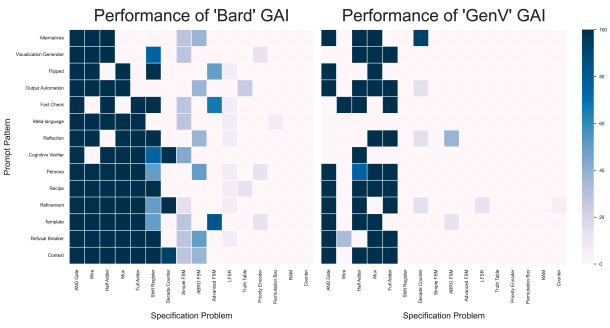
Trust but Verify: How 147 Engineering Students Use Generative AI: Compare your own AI use with 147 engineering students, then explore the survey’s five tables: familiarity with four kinds of AI tools, the tasks students hand to AI, how often they verify each kind of output, and where the line between yes and no falls on each answer scale.
All Publications
Publications
2026




2025




2024





2023





2022










2021







![A University's developmental framework: Creating, implementing, and evaluating a K-12 teacher cybersecurity micro-credential course [Best Paper Award]](/images/papers/iceti-2021-eval.svg)










2020












2019















2018

















2017





2016








2015





2014



2013



2012







2011


2010





2008



2005